
Experiential Retail: A New Lease on Malls
By: Kevin Paul, AIA, NCARB, LEED AP, CFM | Sr. Vice President and Private Sector Real Estate Discipline Director at H2M architects + engineers
For over half a century, shopping malls ruled the retail space. The Southdale Center, widely regarded as America’s first shopping mall, opened in Edina, Minnesota in 1956. Since then, malls have served as quasi-community centers for millions of suburbanites nationwide. In the 1980s, less than three decades after Southdale opened its doors, there were approximately 2,500 malls throughout the United States. However, the rise of online shopping (also known as e-commerce) in the early 2000s led to a gradual decline in attendance at America’s malls, as the prospect of shopping from the comfort of home was simply too good for millions of Americans to pass up.
Brick-and-mortar retail was further burdened by the COVID-19 pandemic, which made in-person shopping riskier and almost necessitated e-commerce as the alternative for every type of product one could imagine. By the end of 2022, only about 700 malls remained in the U.S., a 72-percent decrease in the span of only a few decades.
Month after month of limitations on socializing helped rekindle the urge to congregate with others and led to an uptick in mall and shopping center attendance. The landscape is still shifting, however, and retail developers have to find creative new ways to retain that uptick while further enticing people into returning to the in-person shopping experiences that defined American commerce for much of the 20th century.
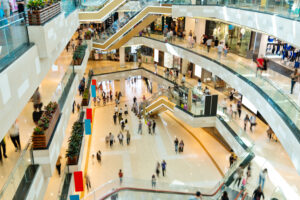
Retail as an Experience
To compete with e-commerce platforms, mall developers have to provide that which e-commerce cannot offer. This means investing in “experiential retail”: creating spaces that offer in-person experiences as a complement to the traditional brick-and-mortar stores.
Experiential spaces can serve as focal points around which the rest of the retail offerings can form and benefit from. For example, an electronics store may not, on its own, be able to court customers away from e-commerce, but a cineplex, a live performance space, or multiple dining options could bring people to the mall and encourage visitors to browse the nearby stores. Buying a new smart watch at an electronics store is generally less convenient than buying one online, but if a customer is already at the mall to see a movie or take in live music, the electronics store becomes a comparably convenient alternative to online shopping.
These experiential spaces do not need to revolve around entertainment, either. The Smith Haven Mall in Lake Grove, NY, is home to Stony Brook Medicine Advanced Specialty Care, a clinic that houses a wide variety of medical specialties and equipment under one roof. The proximity to retail is intentional, as the goal was ultimately to merge retail convenience with the comprehensive healthcare offerings of a clinic environment. Aside from telehealth consultations, which are significantly limited in what they can diagnose, there is no e-commerce alternative comparable to an in-person clinic visit.
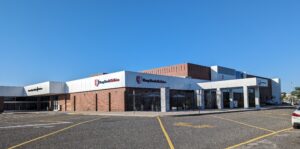
The other benefit of siting such a clinic in a shopping mall environment is that shopping malls already have the infrastructure for medical use, including the ample parking, sanitary capacity, and drainage required to build for medical use. Likewise, the abundance of parking can also help meet similar requirements for cineplexes, concert venues, dining, gaming, and other comparable performance spaces.
The Mall as a Community Center
The idea of experiential retail in malls is not necessarily new. After all, cineplexes have long been a staple of shopping mall offerings, and a number of prominent teenage pop stars in the ‘80s and ‘90s cultivated their early fanbases by performing concerts at malls across America.
The key difference now is in the relationship between the experience of shopping at a mall and the offerings made available by those mall retailers. For malls of the past, the draw for visitors was the ability to conveniently shop for a wide variety of different items under a single roof; the experience of shopping was only secondary. Today, malls can still offer that convenience, but convenience alone will not attract patrons through the door. Therefore, it is imperative that mall developers dedicate spaces to the kinds of experiences and services that cannot be easily replicated online, be it a live performance or a routine checkup. A successful mall will be one in which the retail offerings enhance the experience of visiting the mall, as opposed to the converse.
A multidisciplinary consulting firm is ideal for identifying potential ways to transform retail space into something that can offer unique experiences and/or services. Consultants with expertise in adaptive reuse can help transform underutilized retail outlets into creative new spaces; Advanced Specialty Care, for example, was once a Sears outlet that received new electrical, plumbing, and HVAC systems and other upgrades to support a healthcare-centered environment. Knowing what sort of architectural and engineering work to expect down the line can help streamline the design process and minimize avoidable costs. Additionally, firms experienced in community outreach can help determine which types of services and experiences are most likely to resonate with local target demographics.
There is a way back for malls, but it involves rethinking the retail experience and how patrons engage with both retailers and each other in the modern age. Thoughtful retail design should combine the experience of shopping with the need to interact with others like one would do at a community center or on the main street of a bustling downtown. These new “town centers” would be the mall’s core offering, emphasizing social interaction around various types of entertainment, rather than just a trip to purchase items. In reimagining these places as community hubs, we can expand the possibilities of what malls can do and help revitalize a cherished American institution.